
Some recent YouTube uploads with Early Modern focus:
Anna Keay, assistant curator at the Tower of London, discusses the arrival of Elizabeth I at the Tower in 1554, suspected of treason against Mary.
Also uploaded (in 4 parts) is is David Starkey on Oliver Cromwell and the Civil War, from his history of the British monarchy
Ghosts of the English Civil War relates spooky encounters on the site of the Battle of Marston Moor in 1644.
Dylan Winter tells the story of "possibly our greatest naval humiliation": the Dutch raid on the Medway in 1667.
Showing posts with label Battles. Show all posts
Showing posts with label Battles. Show all posts
05 July, 2008
Recent YouTube uploads


28 September, 2007
The Battle of the Kentish Knock, 28th September, 1652

An important 17thC naval battle from the First Anglo-Dutch War for today's post. The Kentish Knock is one of the sand bars off the entrance to the Thames Estuary, close to one of the usual anchorages of the English fleet at the Downs.
The background to the battle was the English Civil War, which had finally ended a year earlier when Cromwell's Parliamentary army defeated Charles II's supporters at Worcester in 1651.
The war had weakened England's control over commerce and trade, and escalating skirmishes between Dutch and English forces made war inevitable as the Dutch tried to challenge English control over valuable trade routes to the Indies, etc.
The Dutch were hampered by drunk crews and rebellious Zealanders who sailed home halfway through the battle, and the result was a victory for the Commonwealth of England, although the Dutch managed to withdraw with much of their fleet intact, chased by the English.
For more on the battle, see Wikipedia and this site.
note on dates: most sources have the date of the battle as 28th September, which is the date according to the Julian calendar used in England up to 1752; the Wikipedia entry uses the modern Gregorian calendar date of 8th October.
See also previous post on the later Battle of Sole Bay.
Continuing the nautical theme, Cardinal Wolsey's vodpod sidebar features sea shanties this week...the Japanese choir's rendition of "Whisky Johnny" is a hoot.
17 August, 2007
I spy with my little eye, something beginning with A...
 If you haven't seen it, a witty animated version of the Bayeux Tapestry is worth a look on Youtube, complete with appropriate sound effects and Hollywood-style background music in the battle scenes.
More seriously, military historian Gary Smailes asks Should we trust the Bayeux Tapestry?
He also has produced a map of the Battle of Hastings using Google Maps...nifty.
23 June, 2006
The Battle of Solferino (23rd June, 1859)

French under Napoleon III & Italians (more correctly Piedmont-Sardinia) under Victor-Emmanuel II (later first king of Italy) v. Austrians under the young Emperor Franz Joseph (with Germans in reserve). Italians were trying to regain Lombardy and Venetia from five generations of Austrian rule. France had agreed to help and in exchange would receive Savoy and Nice.
Solferino was the greatest land battle since Austerlitz, with 270,000 men clashing for 15 hours from 4 a.m. to 7 p.m. There were 40,000 casualties. In the end the Austrian forces were driven from their positions but the carnage was so great that Napoleon III decided he could not continue with the war; by 11th July he had signed a peace treaty gaining Lombardy for Victor Emmanuel but leaving the Austrians with Venetia. On hearing the news, V-E's prime minister Cavour resigned, declaring that Italy had been betrayed. Italy had to fight another war in 1865 to regain Venetia.
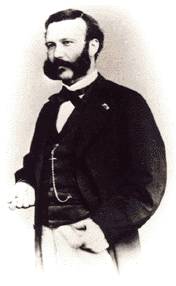
The battle was witnessed by Swiss businessman Henri Dunant (pictured right), who happened to be in the area whilst on a business trip to Italy. He was so deeply moved by the plight of the many wounded, many of whom went on to die of wounds or be finished off by enemy forces, that he wrote his famous book "A Memory of Solferino", and is credited with founding the Red Cross. By 1864, 14 nations had signed the Geneva Convention which covered the treatment of wounded and prisoners.
An grisly extract from his book :
"For several days running I handed out tobacco, pipes and cigars, in the churches and hospitals, where the smell of the tobacco, smoked by hundreds of men, was of great value against the pungent stench which arose as the result of crowding so many patients together in stifling hot buildings. The stocks of tobacco in Brescia were very soon exhausted, and more had to be brought from Milan. Only tobacco could lessen the fears which the wounded men felt before an amputation. Many underwent their operation with a pipe in their mouths, and a number died still smoking"
[thanks to JL for contributing most of this post]
09 June, 2006
6th June, 1672. Battle of Sole Bay
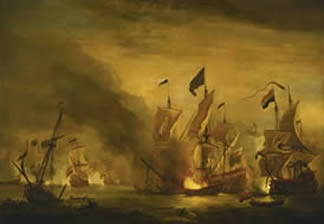
The Battle of Sole Bay formed the main engagement of the Third Anglo-Dutch War, and was a essentially a draw. Sole Bay is off the Suffolk coast near Southwold, and the battle is commemorated on the label of Adnams Broadside bitter (abv 6.3), which is brewed in Southwold.
The English thought they had an agreement with the French fleet to support them against the Dutch navy, but when the Dutch attacked from an unexpected direction, the French made a tactical withdrawal hoping that the English and Dutch fleets would reduce eachother to smithereens. Never trust the French!
There were heavy casualties on both sides: fireships were used to set opposing men-of-war alight, and many sailors were burnt as well as drowned, or hit by cannon shot. Body parts were washed up on the beach for some time afterwards.....nice.
There is an excellent blog devoted to the Anglo-Dutch wars.
Try this link to sample an album of sea shanties on : amazon.com
Subscribe to:
Posts (Atom)
