 As mentioned in a previous post, Dan Snow's recent BBC series Empire of the Seas mentioned the unfortunate fate of Admiral John Byng, executed on his own ship for "failing to engage the enemy" off Minorca.
Snow didn't question the verdict of 1757, and this has prompted Byng's family (who have been running a campaign to clear his name) to pen this letter to the Daily Telegraph:
TV unjust to Admiral Byng
SIR – We are collateral descendants of Admiral Byng, and have reacted to the BBC 2 programme Empire of the Seas in a similar way. While it is excellent to capture the imagination of the public, it is wrong to repeat historical inaccuracies.
Admiral Byng did not “retreat” from Minorca having failed to engage the enemy. After initially engaging with the French, he withdrew to Gibraltar when the enemy had disappeared, in order to mend his battered ships and to tend to his wounded sailors. It was also his duty to defend Gibraltar from the French.
He wrote to the Admiralty asking for reinforcements and stipulated he would then waste no time in attacking the enemy again. This letter was censored by the Admiralty for political reasons. He presented his full-length letter at his court-martial, yet was imprisoned in Greenwich and shot on the Monarch.
What he had written to the Admiralty, on May 25, 1756, was this: “I send their Lordships the resolutions of the council of war, in which there was not the least contention or doubt arose. I hope, indeed, we shall find stores to refit us at Gibraltar; and, if I have any reinforcement, will not lose a moment of time to seek the enemy again, and once more give them battle.”
Thane Byng Nelson
Chris Byng-Maddick
Sarah Saunders-Davies
John Byng-Hall
London NW3
Last year Chris Ware of the University of Greenwich published Admiral Byng : His Rise and Execution which would be a good place to start your own appraisal.
Although unrelated, this reminded me of an entry in the visitors' book at Appomattox: "It's not over".
Sometimes history just won't lie down....
07 February, 2010
Admiral Byng.....it's not over


13 March, 2008
The Sad Demise of Admiral John Byng, 14th March, 1757

Admiral John Byng of the Royal Navy, like Marshal Ney , gave the signal to fire to his own firing squad, in his case by dropping a white handkerchief onto the deck of his flagship "Monarch", on which he was shot at Portsmouth in March 1757.
Byng had been found guilty by court-martial of "failing to do his utmost" in preventing the French capture of Minorca in 1756, at the start of the Seven Years War.
Many thought Byng had been made a scapegoat, and Voltaire wrote about his death in Candide, recording that in England 'it is thought good to kill an admiral from time to time to encourage the others' (pour encourager les autres)
Byng's end is recorded in typically terse naval style in the Master of the 'Monarch's' log recording the execution: 'at 12 Mr Byng was shot dead by 6 Marines and put into his coffin'.
Links: the National Maritime Museum , Peter Davis' site (where you can also download a Windows simulator for a square-rigged frigate) , Dudley Pope's book At 12 Mr Byng was Shot, which makes the case for Byng's defence.
11 September, 2006
Men who commanded their own firing squads part 2: Admiral John Byng, March 1757
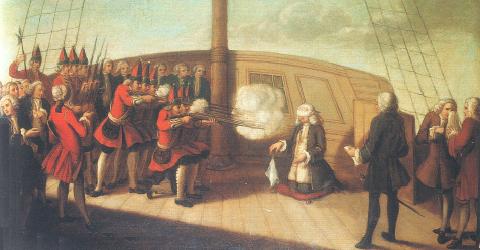
Admiral John Byng of the Royal Navy, like Marshal Ney in last week's post, gave the order to fire to his own firing squad, in his case by dropping a white handkerchief onto the deck of his flagship "Monarch", on which he was shot at Portsmouth in March 1757.
Byng had been found guilty by court-martial of "failing to do his utmost" in preventing the French capture of Minorca in 1756, at the start of the Seven Years War.
Many thought Byng had been made a scapegoat, and Voltaire wrote about his death in Candide, recording that in England 'it is thought good to kill an admiral from time to time to encourage the others' (pour encourager les autres)
Byng's end is recorded in typically terse naval style in the Master of the 'Monarch's' log recording the execution: 'at 12 Mr Byng was shot dead by 6 Marines and put into his coffin'.
Links: the National Maritime Museum , Peter Davis' site (where you can also download a Windows simulator for a square-rigged frigate) , Letters from Voltaire re. Byng on the Voltaire Soc. America site.
Other posts on this blog of naval interest:
The Spanish Armada
The Battle of Sole Bay
The Capture of Napoleon by the Bellerophon

