Two history carnivals well worth checking out:
Sharon Howard at Early Modern Notes hosts an Early Modern edition of Carnivalesque, the 42nd in the series.
Meanwhile over at Osprey Publishing, Mike has put up an Olympics-themed Military History Carnival , and uses some obscure demonstration sports you didn't think were in the Olympics to provide the links (eg Golf...bunker...nuclear bunker). Clever.
Showing posts with label Military History. Show all posts
Showing posts with label Military History. Show all posts
18 August, 2008
Carnival time


05 July, 2008
Recent YouTube uploads

Some recent YouTube uploads with Early Modern focus:
Anna Keay, assistant curator at the Tower of London, discusses the arrival of Elizabeth I at the Tower in 1554, suspected of treason against Mary.
Also uploaded (in 4 parts) is is David Starkey on Oliver Cromwell and the Civil War, from his history of the British monarchy
Ghosts of the English Civil War relates spooky encounters on the site of the Battle of Marston Moor in 1644.
Dylan Winter tells the story of "possibly our greatest naval humiliation": the Dutch raid on the Medway in 1667.
14 June, 2008
Welcome to the 15th Military History Carnival!
Welcome to the 15th Military History Carnival!
This is the first time I have hosted the MHC, and I would like to thank those who have made submissions; thanks also to Gavin for advice on putting the thing together.
Most of the posts included below are my own choice, but I know that I am bound to have missed some great posts out there....
I previously issued some theme ideas for the carnival:
- forgotten (or little known) engagements
- good and bad tactics
- collateral (civilian impact)
- eyewitness accounts
- (lowish rank) individuals who made an impact
- interesting weapons
- book reviews
- contributions to "big debates" (eg is the Civil War over yet)
Many of the posts below support these categories, but have stuck with a basic chronological organisation for the carnival so that readers can zoom in on their favourite era.
OK, off we go.
ANCIENT & MEDIEVAL:
For the Ancient History era, Mark at the Skwib presents another quality edition of The Lost PowerPoint Slides: Trojans and Triremes? It?s All Greek to Everyone! (Part 6.1)
Milica at SCAtoday reports on the UK Arts and Humanities Research Council project The Soldier in Later Medieval England which started in 2006 and is producing regular output, including the Soldier of the Month .
Lafayette C. Curtis at I, Clausewitz busts the myth about clerics and bludgeoning weapons in medieval Europe.
EARLY MODERN:
Lafayette Curtis submitted Actions of Lowe countries, Gordon Frye's History Ramblings' report of a detailed reenactment of a late 16th-century military camp in California.
By way of contrast, Mrs Drudge at The Drudgeries reports on an unimpressive reenactment of the Battle of Maidstone in the English Civil War: "a mixture of fat old men and gal troops halfheartedly struggling up Gabriels Hill . More on this important battle here .
In a post entitled Of Seas and Ships and Spanish Sailors, the eery Dragon History blog of Stromness notes the legacy of the Spanish Armada in the Orkney Islands.
Gavin at Investigations of a Dog reviews War and Gender by Joshua Goldstein
Inspired by early memories of watching the Last of the Mohicans, Alex at Military History and Warfare sets out to discover the real story of the "massacre" at Fort William Henry during the French and Indian Wars in 1757
Konrad at Froginawell presents a Chinese Description of C17th Dutch Suicide Tactics using contemporary accounts (submitted by fellow amphibian Alan).
I was given the OK by MHC high command to include some posts or reviews from the H-Net Discussion network. In H-War , Oliver Walton reviews a biography of a Forgotten Star of the Royal Navy.
AMERICAN CIVIL WAR:
David Woodbury at of Battlefields and Bibliophiles revisits a favourite book on the Civil War, and interviews the author. Hat tip to Dimitri Rotov at Civil War Bookshelf
Paul Taylor at With Sword and Pen recommends The Golden Age of Battlefield Preservation by Prof. Timothy Smith, which tells the story of how dedicated veterans set out to preserve the battle sites of Chickamauga, Antietam, Shiloh, Vicksburg, and Gettysburg in the 1890's.
Maggie at Civil War Women tells the story of Fanny Lawrence Ricketts, who after tracking down her wounded husband James in a makeshift field hospital, writes in her diary: "As I look from the window I see a severed leg under a tree. It has been there all day, and I intend asking to have it removed."
T J Linzy at Battlefield Biker tells the story of the Battle of New Hope Church complete with his customary motorbike ride suggestion.
In H-CivWar, Paul Quigley commends Jason Philips' 2007 book on Diehard Rebels.
Meanwhile, Harry Smeltzer at Bull Runnings has the rug pulled from under his digital history project by the demise of Microsoft Live Search.
THE GREAT WAR:
In Because our Fathers Lied , Francis Beckett of the Guardian reviews four new books about soldiers' experiences in the First World War, which he compares to the death of his own grandfather - hat tip to Ralph E Luker at Cliopatria .
Stories of wartime relatives are posted on many family history blogs: Bob Lord (WW2 USAF) at LordandLady tells the story of relative Martin Cumming of the 48 Highland Regiment , 1st Canadian Division; his post reminds us of the scarcely believable daily casualty figures in the Great War.
Ross Mahoney at Thoughts on Military History discusses Gallipoli, Combined Operations and Air Power.
John Quiggin at Crooked Timber has a great post on The Great and Unremembered War, which has an impressive set of comments attached. In particular I draw your attention to comment #2 is from Stuart, on leadership failure as explained by Blackadder. Magic.
This post was also featured in History Carnival LXV at Progressive Historians. Jeremy Young included a number of other good posts on Military History in this broad-ranging carnival which is cleverly built around the idea of a US Presidential Debate: most of the Mil Hist recommendations of course come from vet John McCain!
A couple of dead Germans: Christofer Eger at Suite101 marks the passing of the Kaiser's Last Soldier, while Executed Today remembers the death by French firing squad in 1923 of early Nazi cum freedom fighter Albert Leo Schlageter, who tried to sabotage the French occupation of the Ruhr in 1923 by blowing up railway lines, and inevitably became a martyr figure for the Nazis.
WORLD WAR 2:
Several important WW2 anniversaries have just passed. For D-Day (6th June, 1944), Zenpundit gives us Ronald Reagan's heartfelt speech from the 40th anniversary in 1984. In part of his speech Reagan bemones the fact that Eastern Europe was still under Soviet occupation - not for long.
Aussie Navy veteran Mackenzie J Gregory at Ahoy has a copy of an important signal which officers on HMAS Nizam drew lots to keep. A huge amount of dedication clearly goes into this blog, which has over 1600 articles.
Raul Colon at The Sub Report tells us what happened to the U-Boat bases and pens after the war - the unlucky ones were used for bombing practice, but others are still in use today.
The carrier pilots of the Battle of Midway (4th-7th June, 1942) are remembered by El Jefe Maximo at Kingdom of Chaos.
Brett Holman at Airminded has a fascinating post on how much time British air defences had to intercept air attacks during both WW1 and WW2. Brett estimates that The Chain Home radar system increased the time available to get Hurricanes and Spitfires into position from 5 minutes to around 40 minutes...without it, we would clearly have been in a spot of bother.
Let's also include a post to recognise the place that Wargamers have in the military history blogosphere. I was impressed with the D-Day landscape created by the Bedford Gladiators Wargame and Role Play Club.
English Russia has some great photos of the moment when a Red Army veteran is re-united with his tank. You may need to scroll down past the ads for "beautiful Russian girls"[you can always scroll back up]. The same blog also has an interesting item on the Sevastopol Defense Panorama.
POST-WAR:
Mark Grimsley at Blog Them out of the Stone Age asks Will the Munich analogy ever outlive its usefulness?. Comments are worth reading as well.
Charles J Hanley reports on Mass Killings in S.Korea in 1950 killings of suspected leftists at start of Korean War (hat tip - RE Luker, again)
Mark Walker, "A 20th-Century Faust," American Scientist, May/June, reviews Michael J. Neufeld's Von Braun: Dreamer of Space, Engineer of War . (hat tip: guess who).
Kennedy Hickman's About.Com Military History blog makes a contribution to the obscure weapons strand with the story of how a prototype Cold War bomber met its end on a photo shoot
MEMORIAL DAY:
I came across a number of thoughtful posts prompted by Memorial Day in the USA.
From Vermont, Andrew Barton at Meeyauw remembers Charles Devereux, a casualty at Cedar Creek in 1864.
Millard Fillmore's Bathtub has tips on correct flag protocol
Also, Bob Waters at Watersblogged on why The Poppies Still Grow
OTHER STUFF:
Here are a few things I came across whilst researching the carnival , although outside the blogosphere:
I received a carnival submission for this Free Wordpress Theme: WP Special Tactics - should be a hit with the paintballing brigade....
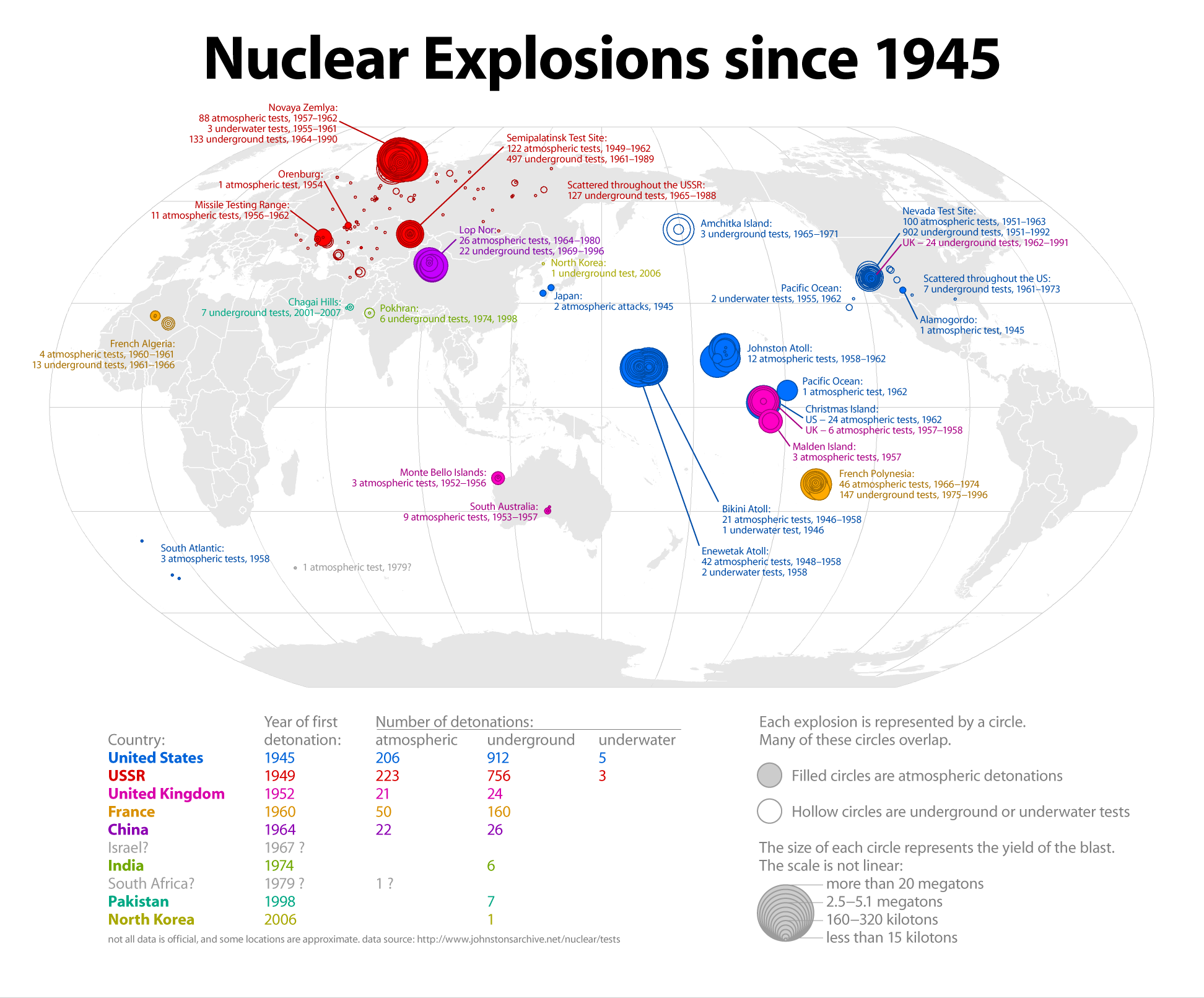
RadicalCartography has a map of nuclear tests since 1945, atmospheric, underground and underwater. Still going on of course in Pakistan and N.Korea.
bestpicsaround has shots of a German tank being pulled out of a lake - can anyone identify it?
FDR's fireside chats are available at OldRadioWorld
THANKYOU:
I hope you enjoy reading these posts. The next edition of the Military History Carnival will be on 18th August (no host for July so we're skipping it) at Osprey Publishing blog.
Submissions can be e-mailed to blog at ospreypublishing dot com
By way of a postscript, Pushkin at WebUrbanist shows us 12 Compelling Monuments Dedicated to Peace
15 May, 2008
The 14th Military History Carnival is up

The 14th Military History Blog Carnival is up at Investigations of a Dog.
The theme is "Contested Boundaries" and Gavin Robinson has assembled lots of interesting posts not just on disputed borders, but also other boundaries (when is a 'terrorist' a 'freedom fighter', what constitutes a 'war crime', the roles of men and women in conflicts, etc).
The next edition of the Military History Carnival will be right here on 14th June. Please email submissions to me at alunadler at yahoo dot co dot uk, or use the submission form. I am thinking of some potential themes such as "eyewitness history" - feel free to make a suggestion for a theme...
24 January, 2008
Cardinal Wolsey and the Tudor Navy

You may have spotted via my Shelfari widget that I have been reading David Childs' excellent ship biography The Warship Mary Rose. The Mary Rose was Henry VIII's flagship until she sank in home waters in 1545, having taken part in three wars against France and one against Scotland.
The Mary Rose was famously salvaged in 1982 and her remains are now displayed at Portsmouth Historic Dockyard. A major project is under way by the Mary Rose Trust to build a fab new permanent exhibition to display the hull and exhibits, inevitably dependent on a large injection of dosh from Lottery funding. The decision on this is due TOMORROW Jan 25th, so fingers crossed!
Amongst the primary sources quoted by Childs are letters between Cardinal Wolsey and captains of the Mary Rose concerning the ships provisions (or lack of) and other matters. As the King's Master Almoner, Wolsey "...was able to demonstrate that the idea of a standing navy was a sustainable one." (Childs, ibid, p.89).
Childs also quotes Wolsey's biographer Francis Hacket:
"[Wolsey] personally signed contracts for everything from twenty-five thousand fat oxen for salting to the hire of fourteen mares to haul a culverin (cannon)" (ibid, p.90).
One of the problems that Wolsey seems to have encountered is that empty barrels were not returned by the navy to shore for re-filling with provisions - many were simply thrown overboard. Hence this extract from a letter to (Admiral) Thomas Howard in 1513:
"My lord, I assure you it is not possible to furnish your revictualling if Foists (barrels) be not
more plenteously brought from the navy to Hampton than they be....for ye cannot be provided elsewhere of any foists for money" (ibid, p.96).
Wolsey's rather statistical reaction to the loss of the warship Regent, blown up off Brittany in 1513 along with the French ship Cordeliere, is revealed in this extract from a letter to the Bishop of Worcester:
"And after innumerable shootings of guns and long chasing one another, at the last the Regent most valiantly boarded the [Cordeliere], wherein were 4 lords, 300 gentlemen, 800 soldiers and mariners, 400 crossbowmen, 100 gunners, 200 tunnes of wine, 100 pipes of beef, 60 barrles of gunpowder and 15 great brass cortains with so marvelous number of shot and guns of every sort" (ibid, p108).
After this bloody action in which up to 2000 men on both sides were killed, Henry decided to construct the Woolwich Dockyard to build more ships.
08 January, 2008
Fire in the Hole! Military History Carnival #10

The 10th edition of the Military History Carnival is up at Walking the Berkshires.
It is dedicated to the creator of the Flashman novels, George MacDonald Fraser, who died recently, with lots of neat Flashman references.
28 September, 2007
The Battle of the Kentish Knock, 28th September, 1652

An important 17thC naval battle from the First Anglo-Dutch War for today's post. The Kentish Knock is one of the sand bars off the entrance to the Thames Estuary, close to one of the usual anchorages of the English fleet at the Downs.
The background to the battle was the English Civil War, which had finally ended a year earlier when Cromwell's Parliamentary army defeated Charles II's supporters at Worcester in 1651.
The war had weakened England's control over commerce and trade, and escalating skirmishes between Dutch and English forces made war inevitable as the Dutch tried to challenge English control over valuable trade routes to the Indies, etc.
The Dutch were hampered by drunk crews and rebellious Zealanders who sailed home halfway through the battle, and the result was a victory for the Commonwealth of England, although the Dutch managed to withdraw with much of their fleet intact, chased by the English.
For more on the battle, see Wikipedia and this site.
note on dates: most sources have the date of the battle as 28th September, which is the date according to the Julian calendar used in England up to 1752; the Wikipedia entry uses the modern Gregorian calendar date of 8th October.
See also previous post on the later Battle of Sole Bay.
Continuing the nautical theme, Cardinal Wolsey's vodpod sidebar features sea shanties this week...the Japanese choir's rendition of "Whisky Johnny" is a hoot.
17 August, 2007
I spy with my little eye, something beginning with A...
 If you haven't seen it, a witty animated version of the Bayeux Tapestry is worth a look on Youtube, complete with appropriate sound effects and Hollywood-style background music in the battle scenes.
More seriously, military historian Gary Smailes asks Should we trust the Bayeux Tapestry?
He also has produced a map of the Battle of Hastings using Google Maps...nifty.
23 June, 2006
The Battle of Solferino (23rd June, 1859)

French under Napoleon III & Italians (more correctly Piedmont-Sardinia) under Victor-Emmanuel II (later first king of Italy) v. Austrians under the young Emperor Franz Joseph (with Germans in reserve). Italians were trying to regain Lombardy and Venetia from five generations of Austrian rule. France had agreed to help and in exchange would receive Savoy and Nice.
Solferino was the greatest land battle since Austerlitz, with 270,000 men clashing for 15 hours from 4 a.m. to 7 p.m. There were 40,000 casualties. In the end the Austrian forces were driven from their positions but the carnage was so great that Napoleon III decided he could not continue with the war; by 11th July he had signed a peace treaty gaining Lombardy for Victor Emmanuel but leaving the Austrians with Venetia. On hearing the news, V-E's prime minister Cavour resigned, declaring that Italy had been betrayed. Italy had to fight another war in 1865 to regain Venetia.
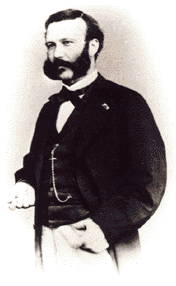
The battle was witnessed by Swiss businessman Henri Dunant (pictured right), who happened to be in the area whilst on a business trip to Italy. He was so deeply moved by the plight of the many wounded, many of whom went on to die of wounds or be finished off by enemy forces, that he wrote his famous book "A Memory of Solferino", and is credited with founding the Red Cross. By 1864, 14 nations had signed the Geneva Convention which covered the treatment of wounded and prisoners.
An grisly extract from his book :
"For several days running I handed out tobacco, pipes and cigars, in the churches and hospitals, where the smell of the tobacco, smoked by hundreds of men, was of great value against the pungent stench which arose as the result of crowding so many patients together in stifling hot buildings. The stocks of tobacco in Brescia were very soon exhausted, and more had to be brought from Milan. Only tobacco could lessen the fears which the wounded men felt before an amputation. Many underwent their operation with a pipe in their mouths, and a number died still smoking"
[thanks to JL for contributing most of this post]
09 June, 2006
6th June, 1672. Battle of Sole Bay
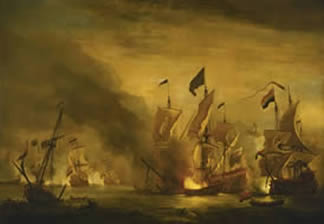
The Battle of Sole Bay formed the main engagement of the Third Anglo-Dutch War, and was a essentially a draw. Sole Bay is off the Suffolk coast near Southwold, and the battle is commemorated on the label of Adnams Broadside bitter (abv 6.3), which is brewed in Southwold.
The English thought they had an agreement with the French fleet to support them against the Dutch navy, but when the Dutch attacked from an unexpected direction, the French made a tactical withdrawal hoping that the English and Dutch fleets would reduce eachother to smithereens. Never trust the French!
There were heavy casualties on both sides: fireships were used to set opposing men-of-war alight, and many sailors were burnt as well as drowned, or hit by cannon shot. Body parts were washed up on the beach for some time afterwards.....nice.
There is an excellent blog devoted to the Anglo-Dutch wars.
Try this link to sample an album of sea shanties on : amazon.com
Subscribe to:
Posts (Atom)