
I recently stumbled the Virtual Exhibitions page of the Bibliotheque Nationale de France (BNF to its friends), which conveniently has an English translation button.
The site a) looks fab and b) has plenty of interesting content.
Enlightenment ("Lumieres") charts "the passage from obscuranticism to free thought and free actions, illuminated by reason" from the mid-C18th onwards . The presentation is grouped around the themes of religion, science, the individual, public space, the political order, universality, and heritage.
There are plenty of pertinent quotes, and I like this one from Voltaire (picture above):
"If England had only one religion, despotism would have to be feared; if she had two, they would cut each other's throats, but since there are thirty, the English live in peace with one another." (1734)
Also to enjoy are beautifully presented expositions on Medieval Bestiary and Medieval Gastronomy.
Merveilleux!
02 November, 2009
Virtual Exhibitions of the Bibliotheque Nationale de France


15 September, 2008
Saint-Malo and the Infernal Machine
 Photo: Sunset from the ramparts of Saint-Malo.
I have resolved to blog with renewed zeal to reward the interest of all my new readers. So we travel to north-western France, destination for Cardinal Wolsey's last holiday in late August, for the first in a series of vacation posts.
The overnight ferry from Her Majesty's Dockyard in Portsmouth to Saint-Malo is a good choice - you get to review the British fleet on the way out (at least the ships not yet sold to Chile) and arrive in the morning at the gateway to Brittany. Very civilised, even with the children intoning "are we there yet?" as we steamed past the Isle of Wight.
Most Brits will drive off the ramp and head west or south without looking at Saint-Malo, but this is a mistake, as this historic town has lots to offer. The impressive walled citadel was once home to pirates and privateers, although most of the buildings are reconstructions. Unfortunately Gen.Patton had a little trouble dislodging the Germans in 1944, and 80% of the original citadel was flattened.
What of the "Infernal Machine?". Until WW2, Saint-Malo was never captured, in spite of many attempts by the Brits to do so (we didn't like towns that hosted privateers and corsairs). In 1673, during William of Orange's conflict with Louis XIV, the Royal Navy tried using an old warship as a powerkeg and set it loose towards Saint-Malo.
There is a good description what happened next in this piece on Admiral Benbow, who was in command.
"The vessel took the form of a barque crammed with upwards of a hundred barrels of gunpowder, roofed over with a ceiling of planks and covered with thatch, faggots of wood, pitch, tar, resin; in short, anything that burned. On top of all that came the missiles. Canon-balls of iron and stone, bombs, iron chains and shells were wrapped in tarpaulin".
The ploy failed when the wind changed, and it blew up against some rocks with an almighty bang. The citadel was rocked and damaged, but the English did not attempt to take it (lack of enough marines).
More English bombardments in 1695 also failed to defeat the defences, which were later strengthened further by the great military architect Vauban.
Anyway, here's an earlier unsuccesful attempt to take a French castle!
07 April, 2008
Holiday Notes Easter 2008

Cardinal Wolsey was on holiday in France last week, and was pleased to pass a sign on the autoroute pointing out the Champ du Drap d'Or (Field of the Cloth of Gold), near to Calais.
This was the extravagant meeting in 1520 between Henry VIII and Francis I, suggested by myself. Each monarch tried to outdo the other in pomp and display of riches.
It was rather expensive for taxpayers on both sides, and failed to result in an Anglo-French alliance, which was the original idea.
In the relevant episode in TV's The Tudors, Henry wrestles Francis in a manly way, loses, and throws some chairs around. Grr!
08 July, 2007
Joan of Arc found innocent, 7th July, 1456

Joan of Arc was finally declared innocent of heresy by Inquisitor-General Jean Brehal on 7th July 1456, 25 years after her death at the stake.
Some more modern cases of those found innocent or pardoned after their executions:
More than 300 British soldiers shot for cowardice or desertion in World War One 1914-18. The link is to a BBC article including personal stories. However, the Army Act of 2006 that enacted the pardon stated that it "does not affect any conviction or sentence."
Lena Barker, a black maid sent to the electric chair in 1945 for killing a white man she said had enslaved her: pardoned in 2005. The link is to the US National Public Radio site, including an audio podcast.
This year, relatives of Admiral John Byng, executed in 1757 for failing to "do his utmost", petitioned the Ministry of Defence for a posthumous pardon, but were turned down.
31 October, 2006
Dunkirk pt 2 - play golf in a fort
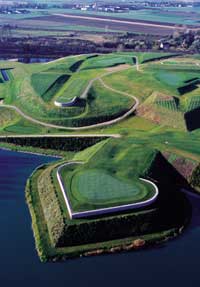
As a follow-up to yesterday's post, check out this Dunkirk golf course within what looks like a coastal fort - impressive.
30 October, 2006
Charles II sells Dunkirk to the French, 27th October, 1662.

For this week's post we go back to Charles II's sale of Dunkirk to France on 27th October, 1662. The price was a reasonable 2.5m livres, or around £400,000 (partly paid in installments).
The map on right "Plan de la Ville et Citadelle de Dunkerque" dates from the early 18thC, but the original drawing is believed to date from 1662. This is from the excellent University of Jerusalem Geography dept. historic cities website.
Samuel Pepys makes several mentions of the Dunkirk sale in his diary ("This day come the King's pleasure-boats from Calais, with the Dunkirk money, being 400,000 pistolles." 21-Nov-1662), and there are further contributions from readers of the Pepys diary retro-blog.
Link to previous posts:
Samuel Pepys learns his uncle has died
Indians sell Manhattan Island for $24 in cloth and buttons, 1626
07 September, 2006
Execution of Marshal Ney, 1815
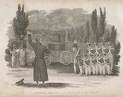
This blog occasionally makes an excursion into the Napoleonic period (see previous posts on Napoleon's final surrender to the English Navy and Napoleon's death on St.Helena ), and today's post commemorates the death by firing squad (commanded by himself - how's that for guts) of Marshal Ney in December 1815.
Ney was knows as "le Rougeaud" (he had ginger hair), and was a popular general, but attracted enemies firstly by siding with the Bourbons while Napoleon was on Elba, and secondly poor tactics at Quatre-Bras and Waterloo.
Bruno Nackaerts's article on the lack of opposition to Ney's execution includes mention of two good conspiracy theories - one that Wellington felt guilty and arranged for a mock execution with Ney spirited away to America where he became Peter Ney, a schoolteacher; the other conspiracy theory is another mock execution arranged by the masons, complete with stage blood!
Incidentally, the excellent Fondation Napoleon site has an interesting article on Napoleon's famous hat ('whilst most of his officers wore their hats "en colonne", that is, perpendicular to the shoulders, Napoleon wore his "en bataille", that is, with the corns parallel to shoulders').
There is also a link to various primary sources on the Napoleonica site, as well as some fun stuff - how about a classy Napoleonic e-card to your history buddies?.
14 July, 2006
This Day in History - Bastille Day, 14th July.

This Day in History for July14th is of course Bastille Day. If you'd like to listen to a rousing version of La Marseillaise, here is a link . The lyrics are bloodthirsty, but good for rousing the troops.
Something a little bit different for today's post is some literary history, from the Writer's Almanac website from US public radio, which I have just discovered via Bloglines. Click on this link to hear the wonderful Garrison Keillor (pictured) tell you about literary anniversaries today (Owen Wister, Woody Guthrie, and Isaac Singer) , and as a bonus he also reads a poem.


