
Admiral John Byng of the Royal Navy, like Marshal Ney , gave the signal to fire to his own firing squad, in his case by dropping a white handkerchief onto the deck of his flagship "Monarch", on which he was shot at Portsmouth in March 1757.
Byng had been found guilty by court-martial of "failing to do his utmost" in preventing the French capture of Minorca in 1756, at the start of the Seven Years War.
Many thought Byng had been made a scapegoat, and Voltaire wrote about his death in Candide, recording that in England 'it is thought good to kill an admiral from time to time to encourage the others' (pour encourager les autres)
Byng's end is recorded in typically terse naval style in the Master of the 'Monarch's' log recording the execution: 'at 12 Mr Byng was shot dead by 6 Marines and put into his coffin'.
Links: the National Maritime Museum , Peter Davis' site (where you can also download a Windows simulator for a square-rigged frigate) , Dudley Pope's book At 12 Mr Byng was Shot, which makes the case for Byng's defence.
13 March, 2008
The Sad Demise of Admiral John Byng, 14th March, 1757


08 July, 2007
Joan of Arc found innocent, 7th July, 1456

Joan of Arc was finally declared innocent of heresy by Inquisitor-General Jean Brehal on 7th July 1456, 25 years after her death at the stake.
Some more modern cases of those found innocent or pardoned after their executions:
More than 300 British soldiers shot for cowardice or desertion in World War One 1914-18. The link is to a BBC article including personal stories. However, the Army Act of 2006 that enacted the pardon stated that it "does not affect any conviction or sentence."
Lena Barker, a black maid sent to the electric chair in 1945 for killing a white man she said had enslaved her: pardoned in 2005. The link is to the US National Public Radio site, including an audio podcast.
This year, relatives of Admiral John Byng, executed in 1757 for failing to "do his utmost", petitioned the Ministry of Defence for a posthumous pardon, but were turned down.
11 September, 2006
Men who commanded their own firing squads part 2: Admiral John Byng, March 1757
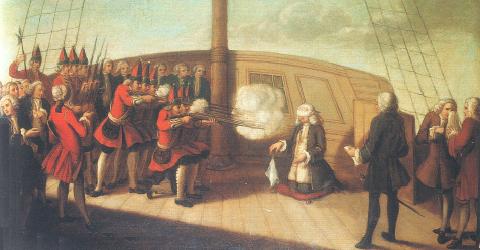
Admiral John Byng of the Royal Navy, like Marshal Ney in last week's post, gave the order to fire to his own firing squad, in his case by dropping a white handkerchief onto the deck of his flagship "Monarch", on which he was shot at Portsmouth in March 1757.
Byng had been found guilty by court-martial of "failing to do his utmost" in preventing the French capture of Minorca in 1756, at the start of the Seven Years War.
Many thought Byng had been made a scapegoat, and Voltaire wrote about his death in Candide, recording that in England 'it is thought good to kill an admiral from time to time to encourage the others' (pour encourager les autres)
Byng's end is recorded in typically terse naval style in the Master of the 'Monarch's' log recording the execution: 'at 12 Mr Byng was shot dead by 6 Marines and put into his coffin'.
Links: the National Maritime Museum , Peter Davis' site (where you can also download a Windows simulator for a square-rigged frigate) , Letters from Voltaire re. Byng on the Voltaire Soc. America site.
Other posts on this blog of naval interest:
The Spanish Armada
The Battle of Sole Bay
The Capture of Napoleon by the Bellerophon
07 September, 2006
Execution of Marshal Ney, 1815
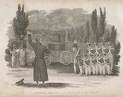
This blog occasionally makes an excursion into the Napoleonic period (see previous posts on Napoleon's final surrender to the English Navy and Napoleon's death on St.Helena ), and today's post commemorates the death by firing squad (commanded by himself - how's that for guts) of Marshal Ney in December 1815.
Ney was knows as "le Rougeaud" (he had ginger hair), and was a popular general, but attracted enemies firstly by siding with the Bourbons while Napoleon was on Elba, and secondly poor tactics at Quatre-Bras and Waterloo.
Bruno Nackaerts's article on the lack of opposition to Ney's execution includes mention of two good conspiracy theories - one that Wellington felt guilty and arranged for a mock execution with Ney spirited away to America where he became Peter Ney, a schoolteacher; the other conspiracy theory is another mock execution arranged by the masons, complete with stage blood!
Incidentally, the excellent Fondation Napoleon site has an interesting article on Napoleon's famous hat ('whilst most of his officers wore their hats "en colonne", that is, perpendicular to the shoulders, Napoleon wore his "en bataille", that is, with the corns parallel to shoulders').
There is also a link to various primary sources on the Napoleonica site, as well as some fun stuff - how about a classy Napoleonic e-card to your history buddies?.
23 July, 2006
Thomas Cromwell beheaded on Tower Hill. 23rd July, 1540.
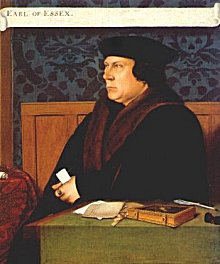
History.net has the date of Thomas Cromwell's demise as 23rd July, although most other sources have the 28th. Anyway, he is featured in today's Tudor post .
Thomas Cromwell (portrait by Hans Holbein jr above)began his government service as secretary to Cardinal Wolsey, and following Wolsey's fall from grace, rose rapidly to prominence as one of Henry VIII's key managers.
His key period of influence was the 1530's, but fame could be shortlived during this period....
In 1538 Henry described Cromwell to the French ambassador as "A good household manager, but not fit to meddle in the affairs of kings".
Cromwell probably took the blame for the fact that Henry claimed he was not informed of the poor physical shape of Anne of Cleves before it was too late to stop the marriage (which Cromwell had arranged).
But there were many of Wolsey's old enemies out to get him, and it was probably only a matter of time before he would be out-manouvered.
Good links to find out more are Englishhistory.net, and the BBC History site.

