02 November, 2012
The All Saints Flood of 1570
Drawing: Hans Moser, Scheldt Flood, 1570(wiki)
As we look at the images of the aftermath of Hurricane Sandy in the Northeast USA his week, here's a reminder of a devastating 16thC flood in Holland which took place this week in 1570. This was the All Saints' Flood (Allerheiligenvloed) which may have killed 20,000 in Holland and neighbouring countries, leaving many more thousands homeless.
In fact there are a series of All Saints' (Aller Heiligen) floods along the North Sea coasts of Holland, Belgium, and Germany, all taking place on or around 1st November, All Saints Day. Others took place in 1170, 1532, 1675 and most recently in 2006.
The 1570 flood took place at a critical point in the history of the Netherlands. Tax reforms had led to increasing dissatisfaction with the rule of the Spanish king Philip II and his governor, and the flood only compounded the general feelings of unrest.
By 1581 the Dutch Republic had been formed and the foundations were being laid for the Dutch golden age of exploration and influence. Although Elizabeth I of the England sent troops under Robert Dudey to assist the Dutch against the Spanish, England and Holland would end up in conflict as Dutch naval power grew in the 17thC.
references:
www.bibliotheek.nl
www.wikipedia.com
Posted by
cardinal_wolsey
at
3:16 PM
0
comments
Labels: 16th Century History, Anglo-Dutch Wars, Dutch history, Elizabeth I, Floods, Maritime History
05 July, 2008
Recent YouTube uploads

Some recent YouTube uploads with Early Modern focus:
Anna Keay, assistant curator at the Tower of London, discusses the arrival of Elizabeth I at the Tower in 1554, suspected of treason against Mary.
Also uploaded (in 4 parts) is is David Starkey on Oliver Cromwell and the Civil War, from his history of the British monarchy
Ghosts of the English Civil War relates spooky encounters on the site of the Battle of Marston Moor in 1644.
Dylan Winter tells the story of "possibly our greatest naval humiliation": the Dutch raid on the Medway in 1667.
Posted by
cardinal_wolsey
at
11:00 PM
0
comments
Labels: Anglo-Dutch Wars, Battle of Marston Moor, Battles, English Civil War, Maritime History, Military History, naval history, Oliver Cromwell
28 September, 2007
The Battle of the Kentish Knock, 28th September, 1652

An important 17thC naval battle from the First Anglo-Dutch War for today's post. The Kentish Knock is one of the sand bars off the entrance to the Thames Estuary, close to one of the usual anchorages of the English fleet at the Downs.
The background to the battle was the English Civil War, which had finally ended a year earlier when Cromwell's Parliamentary army defeated Charles II's supporters at Worcester in 1651.
The war had weakened England's control over commerce and trade, and escalating skirmishes between Dutch and English forces made war inevitable as the Dutch tried to challenge English control over valuable trade routes to the Indies, etc.
The Dutch were hampered by drunk crews and rebellious Zealanders who sailed home halfway through the battle, and the result was a victory for the Commonwealth of England, although the Dutch managed to withdraw with much of their fleet intact, chased by the English.
For more on the battle, see Wikipedia and this site.
note on dates: most sources have the date of the battle as 28th September, which is the date according to the Julian calendar used in England up to 1752; the Wikipedia entry uses the modern Gregorian calendar date of 8th October.
See also previous post on the later Battle of Sole Bay.
Continuing the nautical theme, Cardinal Wolsey's vodpod sidebar features sea shanties this week...the Japanese choir's rendition of "Whisky Johnny" is a hoot.
Posted by
cardinal_wolsey
at
10:19 PM
0
comments
Labels: 17th Century History, Anglo-Dutch Wars, Battle of Kentish Knock, Battles, Maritime History, Military History, naval history
09 June, 2006
6th June, 1672. Battle of Sole Bay


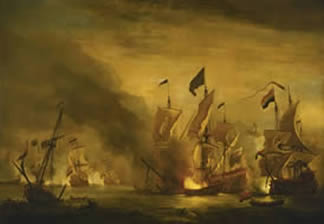
The Battle of Sole Bay formed the main engagement of the Third Anglo-Dutch War, and was a essentially a draw. Sole Bay is off the Suffolk coast near Southwold, and the battle is commemorated on the label of Adnams Broadside bitter (abv 6.3), which is brewed in Southwold.
The English thought they had an agreement with the French fleet to support them against the Dutch navy, but when the Dutch attacked from an unexpected direction, the French made a tactical withdrawal hoping that the English and Dutch fleets would reduce eachother to smithereens. Never trust the French!
There were heavy casualties on both sides: fireships were used to set opposing men-of-war alight, and many sailors were burnt as well as drowned, or hit by cannon shot. Body parts were washed up on the beach for some time afterwards.....nice.
There is an excellent blog devoted to the Anglo-Dutch wars.
Try this link to sample an album of sea shanties on : amazon.com
Posted by
cardinal_wolsey
at
10:29 PM
0
comments
Labels: 17th Century History, Anglo-Dutch Wars, Battle of Sole Bay, Battles, Military History, naval history